Monday, 5 August 2013

The Structural Unemployment Delusion


The lingering reverberations of the Great Recession continue to send an unpleasant sting throughout the global economy. Although in the United States we’re witnessing steady—albeit sluggish—growth, effective policy targeted at job creation is still very much needed to reduce ongoing unemployment, which currently stands at 7.4%.

Both the Federal Reserve and policy makers in Washington are meant to implement measures aimed at boosting employment. The efficacy of the policies that they offer depends upon a proper understanding of the nature of unemployment. Currently, a number of underlying causes have been attributed to the ongoing inertia of US jobs growth.  On the one hand, sustained deregulation, a debt-driven housing bubble and fly by night activity on wall street—among a host of other factors—led to the most severe economic downturn since the Great Depression. Unemployment that results from these sources is termed cyclical unemployment.

On the other hand, the transition from a labor-based economy to an increasingly more global and knowledge-based economy is beginning to require the workforce to possess fundamentally different skills. Some assert that these shifts have obfuscated the natural rate of unemployment; they argue that the ongoing high rate of unemployment has little to do with the lingering effects of the recession, but rather is the result of a skill shortage for available jobs. This type of unemployment, stemming from a mismatch between the supply and demand of skills, is termed structural unemployment.


US Unemployment Rate

Each type of unemployment requires a different prescription to overcome. The classic remedy for cyclical unemployment is expansionary monetary and fiscal policy aimed at stimulating the business cycle and boosting aggregate demand. Once demand is restored, the thinking goes, firms will ramp up production and again begin to hire. Structural unemployment, however, is much different in nature and requires a fundamentally different prescription. Because this type of unemployment is the result of a mismatch between the supply and demand of skills, monetary and fiscal policy will do very little, if anything at all, to alleviate it. Instead, the existing incongruity must be reconciled with education and job retraining in order to provide the workforce with the required skills to secure employment.

So, then, what is anchoring employment? Are structural or cyclical factors mainly to blame? The answer is a little bit of both, but, right now, the evidence tells us that it’s mainly cyclical.

 *****


According to the Economic Policy Institute, job vacancies are currently 16% below their prerecession levels. In 2007, there were 1.5 unemployed job seekers for every job vacancy in the US. This ratio jumped to 6.7:1 in 2009, and has since declined to 3.1:1 in April, 2013. As job seekers outnumber job vacancies in every sector, the data strongly suggest that cyclical factors are to blame for weighing on unemployment.

Research from the Brookings Institute has further substantiated this claim. “Even if we could magically endow all job seekers with precisely the skills needed to find work in expanding industries,” writes Gary Burtless, “we would not have reduced the unemployment rate in the Great Recession very much, and for a very simple reason: There were comparatively few job vacancies to fill.”


Available Jobs to Job Seekers


Does this mean that structural employment isn’t an important concern? No. Structural sources do have a role to play in unemployment, and they will likely become more relevant going forward. But attributing unemployment to structural sources alone, and discarding the efficacy of further monetary and fiscal policy in favor of job retraining—or nothing at all—is both shortsighted and ineffective.

Yes, we should encourage children and young adults to pursue a STEM (science, technology, engineering and math) curriculum, as STEM related fields are expected to be among the fastest growing jobs. But for the 3.6 million unemployed Americans between the ages of 45 and 65, the investment in retraining for a STEM career is unlikely to bear fruit. Return on investment for education is likely only to pay off after a long time horizon—perhaps spanning decades. The closer individuals are retirement, the more unwilling they will be to incur the cost of retraining.

Most notably, the sectors that are expected to have supply shortages in the coming years—including STEM related fields, such as computer science—do not currently have supply shortages. What does this mean? Well, even if an unemployed adult invested in an education in computer science, he or she would still face an environment with fewer jobs than applicants. Moreover, firms are much more likely to tender offers to recent graduates looking to build careers over older applicants nearing retirement.

These findings tell us something very important; namely, expansionary monetary and fiscal policy can still play an important role in alleviating unemployment. Rather than a mismatch between the supply and demand of skill, it is depressed aggregate demand that remains the main source of lingering unemployment. Congress and the Fed must act accordingly if our economy is to recover.

Sunday, 19 May 2013

Hysteria in the Time of Austerity


Originally published in the Imperial Management Review

Prior to the Great Depression, economists conceived of their field as something bordering on a perfect science; capitalism, so it was thought, had proven to be an economic system devoid of major inefficiencies. This point of view, buffeted by the bull market of the 1920s, abruptly disintegrated at the end of that decade, leaving economists aghast at the approaching Great Depression

With traditional monetary policy ineffective, it took a fresh and invasive look at the capitalist system, most notably by John Maynard Keynes, to understand the challenges that capitalist economies faced. In his General Theory of Employment, Interest and Money, Keynes attributed the depression to a lack of private sector demand, which could only be made up by increased government spending. It was the role of the government, said Keynes, to stimulate the economy. This basic idea comprised the policy prescription taken by America and Britain during the 1930s and 1940s.

As memories of the Depression dwindled, economic thinking shifted away from Keynesianism. The efficient markets hypothesis, which conceives of markets as being rational, gained traction. After World War II, monetary policy was effective in combating economic challenges, including soaring inflation of the 1970s. Keynesian fiscal policy no longer seemed necessary and soon fell out of favor.

The success of economics as a field was again trumpeted, with major thinkers touting the merits of economic policy for balancing employment, inflation and growth. The back patting extended in to 2008, with a number of esteemed economists ardently believing their profession to have reached a pinnacle. Complex and beautifully crafted mathematical models conjured up just the right prescriptions to indefinitely maintain the goals of central banks.

And then the housing bubble burst. And global credit markets dried up. And unemployment skyrocketed. And unmanageable sovereign debt engulfed Europe. The Nobel garnished makers of those mathematical models appeared worryingly close to cosmeticians caking on layers of make-up to conceal a severely scarred truth. With the Fed lowering interest rates near the zero-lower bound, monetary policy met its limits. And thus our story begins.


*****

Austerians, who believe that in a recession government should cut deficit spending and make room for private sector investment, faced off against Keynesians, who believe that recessions represent an absence of private sector demand; the government, according to the Keynesians, must increase deficit spending to stimulate the economy. Which policy is the right one is currently at the heart of economic debate.
Although the Austerity v. Stimulus debate is not a new one, the global economic community has yet to reach a consensus on which is really most effective. Context often compounds clear-cut conclusions, and many adherents—in either camp—have a shifty penchant for exaggerating contextual differences to resuscitate their beleaguered ideology.

If the economic elite were to come together to organize an experiment wherein two countries of similar context were to receive two different policy responses during a recession—austerity for one and stimulus for the other—ethical review boards would be spinning like tops trying thwart it. Which country you believe would be the dead guinea pig depends on your perspective. But it’s clear that one of the countries would suffer unnecessarily.

Sometimes, however, the most seminal of experiments occur naturally. Despite their differences, the economies of the United States and the United Kingdom are similar in a number of important ways, including having and borrowing in their own currencies. While the relationship is not 1:1, those who would downplay the similarities will have a fairly conspicuous agenda.

And so the experiment begins. With the inauguration of the coalition government, the United Kingdom began to invoke fiscal austerity; they reneged on Labour’s stimulus program, which saw GDP growth at 2.5% annually, in favor of across the board spending cuts.

George Osborne, Chancellor of the Exchequer, instituted an aggressive policy of deficit reduction and tax increases, effectively foisting contractionary policy on an already sclerotic economy. Government spending, he argued, would crowd out private investment, thereby thwarting further growth and prolonging recession. The answer was simple: curtail government spending.

How has this turned out for the UK? Well, last year its economy shrank .1%, a far cry from the .8% growth it had projected. The most recent report from the Office of National Statistics revealed that the UK narrowly avoided consummating its ongoing flirtation with a triple-dip recession. Despite lowering its growth forecast for 2013 from 2% to 1.2%, Osborne maintained that “it’s a hard road but we are getting there. Britain is on the right track. Turning back now would be a disaster.”

Quite at odds with Osborne, the National Institute for Economic and Social Research has attributed the UK’s sustained depression and its worsening outlook to austerity. Although most European countries followed a path of austerity, some of them are now beginning to shy away from it, after years of negative growth and rising unemployment.

Portugal recently announced a far-reaching stimulus package. Italy’s new Prime Minister has promised to curb austerity programs and begin stimulus. Most notably, perhaps, the IMF has had an about-face with regard to austerity. Christine Lagarde, Managing Director of the IMF, recently impugned the efficacy of Osborne’s deficit reduction plan, warning that cuts are likely hampering growth and prolonging recession.

Moreover, IMF Chief Economist Olivier Blanchard stated that Osborne is “playing with fire” by remaining on a path of austerity.  Blanchard, once a proponent of Britain’s austerity plans, conducted a review of previous IMF projections. He found that countries that engaged in austerity notably underperformed IMF projections of growth. Conversely, countries that took a more Keynesian approach, like the United States, tended to outperformed IMF projections. After reviewing the findings, Blanchard has advanced the IMF’s evolving viewpoint on austerity, stating that raising taxes and cutting spending succeed only is dragging out depression.


*****

Two notable papers serve as the academic pillars for austerity: Alesina and Ardagna’s Large Changes in Fiscal Policy and Reinhart and Rogoff’s Growth in a Time of Debt. Both have been championed as a coup de grace to Keynesianism. Both have been ignominiously refuted.

When we distance ourselves from the dizzying political discourse and focus on the differential outcomes over the last five years, it’s clear which side of the Austerity v. Stimulus debate has triumphed. The United States, with its comparatively more Keynesian approach, has had a comparatively stronger recovery.

According to critics of the Obama Administration, the United States was supposed to be Greece by now. Interest rates were meant to have skyrocketed, deficits to have rapidly expanded, large capital outflows to have abounded and the dollar to have deteriorated.  But none of this transpired. Instead, GDP growth averaged 2.1% since 2009, compared to .9% in the UK. Unemployment is trending downward and is projected to reach 6.5% by next year, and the deficit is expected to shrink to 4% of GDP by 2014.

More than 5 years into the Great Recession, the verdict is clear. The IMF, the World Bank and the WTO have all warned that austerity will hamstring growth and exacerbate unemployment. They were able to look at the data objectively and come to sensible policy recommendations based on empirical evidence.

Yet Austerians cling to their a priori judgments and increasingly refuted ideologies. They refuse to acknowledge the role austerity has played in hindering recovery. We’re hoping to resuscitate our injured guinea pig, but the wheel of death spins on.

Wednesday, 8 May 2013

Technology: Friend or Foe?


The Boston bombings have again led us to a serious question that has yet to be seriously answered. Namely, what measures should be implemented to more effectively preempt terrorism, and how do we balance those measures with our civil liberties?

Tamerlan Tsarnaev, who is thought to have masterminded the bombings, is now known to have engaged in a number of radical content on social media. Tsarnaev’s YouTube account revealed a playlist labeled “terrorism”, videos of an obscure Dagestani jihadist, and a song by Timur Mutsurayev entitled “Life Devoted to Jihad.” Criticisms about the failure to identify Tamerlan Tsarnaev as a potential terrorist are starting to appear, with some commentators asserting that the “signs were there.”

So how could federal authorities have done a better job at fingering the Tsarnaev brothers? Could expanding provisions in the USA Patriot Act have allowed them to identify Tamerlan as a potential terrorist threat and monitor his activities? Perhaps this would have helped the FBI confirm Russian suspicions that he was connected to Chechen militants.

How about the increased use of technology for public safety? Following the attack, the FBI and Boston Police Department were able to identify the Tsarnaev brothers with the help of Closed Circuit Television, or CCTV. Some of the CCTV footage of Dzhokar Tsarnaev’s reaction after the first explosion may now be a key piece of evidence in his prosecution.

Would increasing the number of CCTV cameras in our cities help authorities identify criminals more efficiently and effectively? Moreover, to what extent would the presence of CCTV help deter future crime? CCTV has already proliferated in a number of European countries, such as the United Kingdom where it is welcomed by 90% of Londoners surveyed by UrbanEye.

Technology that improves the government’s ability to identify and monitor criminal activity could reduce crime rates and help prevent a catastrophe like the Boston bombings from occurring in the future. Of course, while technology has an amazing capacity to hamstring crime, it also has an uncomfortable ability to threaten our privacy and undermine fundamental civil liberties. The primary criticism against increased surveillance is that the government would be monitoring possible criminal activity, which may very likely turn out to be non-criminal activity.

Following the Madrid bombings in 2004, Brandon Mayfield, a lawyer from Portland, Oregon, became a suspect after the FBI had erroneously matched his fingerprints with those found on a bag of detonators associated with the attacks. Under provisions of the USA Patriot Act, the FBI began wiretapping Mr. Mayfield’s conversations, conducting secret searches of his home and gathering bank and phone records—acts that normally require probable cause and judicial approval.

While the inclination after a highly symbolic act of violence may be to give the authorities carte blanche to prevent a similar act from occurring again, we must be careful not to let fear shepherd our decision-making. Nor must we fail to seriously consider the extent to which we can implement more invasive security measures without jettisoning our privacy. How often have the utopian societies of science fiction plummeted precariously into dystopian nightmares?

In an ad hoc poll conducted by Marblehead, 69% of respondents reported that Dzhokar Tsarnaev should not have been read his Miranda rights at the time of his arrest. Whether the public safety exemption is a key method for gathering intelligence or a pernicious dismissal of the constitution is a question about which we should not be cavalier.

In the aftermath of September 11th, some of the most important decisions we made were governed by fear. Justice was supplanted by revenge and rational thought was demoted in favor of emotion.

The Tsarnaev brothers may be despicable. Their wickedness has shaken our collective spirit in a way that we have felt far too often this year. But it is precisely when our American spirit is shaken that our constitution must stand firm.

Wednesday, 1 May 2013

Extreme Political Attitudes


Interesting article from the APS:

Having to explain how a political policy works leads people to express less extreme attitudes toward the policy, according to new research published in Psychological Science, a journal of the Association for Psychological Science.
The research suggests that people may hold extreme policy positions because they are under an illusion of understanding — attempting to explain the nuts and bolts of how a policy works forces them to acknowledge that they don’t know as much about the policy as they initially thought.
Psychological scientist Philip Fernbach of the Leeds School of Business at the University of Colorado, Boulder and his co-authors were interested in exploring some of the factors that could contribute to what they see as increasing political polarization in the United States.

Sunday, 28 April 2013

Friday, 19 April 2013

The Reinhart-Rogoff Danger Zone


Paul Krugman's latest column sheds some more light on the idea that we're approaching a danger zone with our national debt:

"Finally, Ms. Reinhart and Mr. Rogoff allowed researchers at the University of Massachusetts to look at their original spreadsheet — and the mystery of the irreproducible results was solved. First, they omitted some data; second, they used unusual and highly questionable statistical procedures; and finally, yes, they made an Excel coding error. Correct these oddities and errors, and you get what other researchers have found: some correlation between high debt and slow growth, with no indication of which is causing which, but no sign at all of that 90 percent “threshold.”
In response, Ms. Reinhart and Mr. Rogoff have acknowledged the coding error, defended their other decisions and claimed that they never asserted that debt necessarily causes slow growth. That’s a bit disingenuous because they repeatedly insinuated that proposition even if they avoided saying it outright. But, in any case, what really matters isn’t what they meant to say, it’s how their work was read: Austerity enthusiasts trumpeted that supposed 90 percent tipping point as a proven fact and a reason to slash government spending even in the face of mass unemployment.
So the Reinhart-Rogoff fiasco needs to be seen in the broader context of austerity mania: the obviously intense desire of policy makers, politicians and pundits across the Western world to turn their backs on the unemployed and instead use the economic crisis as an excuse to slash social programs."

Wednesday, 17 April 2013

Is Our Debt Really That Dangerous?


Perhaps the most frequently asked question Perhaps the most frequently answered question by policymakers relates to the paradox of preempting our long-term debt burden while continuing to stimulate our currently depressed economy. (The asking part is usually omitted).

The deficit hawks assert that we need to cut spending, and cut it now. This, of course, is the intuitive response. For the more money we borrow and spend now, the worse our interest burden becomes in the future. More tax revenue will be used to service our interest payments; we might even borrow to pay off interest on other loans. To compound the issue, entitlement spending is ballooning as social security and healthcare costs continue to grow.

With more and more tax revenue being directed toward interest payments and entitlements, investments in our future—like R&D, education and infrastructure— will increasingly diminish. This combination of slowing growth and dwindling revenue could mean that we are unable to service our current interest burden, resulting in soaring interest rates and even a default on our sovereign debt. The medicine that many prescribe for preventing the chaos is an unpleasant decrease in spending—otherwise known as austerity. Sound logical? Sure it does.

But wait a minute. We happen to be in the worst economic downturn since the Great Depression. Although spending cuts may appear to be the intuitive course of action, the reality may be quite different. In fact, many economists assert that the immediate need for stimulus must supersede the hysteria about our long-term debt.


Why? Because contractionary policies will put us back into recession. The different outcomes between the policy responses of the United Kingdom and the United States offer valuable insight in to what works.

The UK plans to cut the overall spending of government agencies by 10% by next year. While the object of this policy is to bring the deficit to 0%, it has instead only managed to hamstring growth. As a result, the UK is currently about to consummate its ongoing flirtation with a triple-dip recession.

The coalition government in the UK fails to understand that Britain’s primary problem is not growing deficit spending, but a revenue decrease attributable to a depressed economy—of which a growing deficit is a symptom. Foisting contractionary policies on a beleaguered economy cripples recovery. Austerity has left the UK with a sclerotic negative growth rate of -.3%, a far cry from the 4.8% the government expected.


 *****

During a debate with Joe Scarborough on Charlie Rose, economist Paul Krugman forwarded the viewpoint that the immediate need for stimulus must take precedence over the long-term debt challenge. He remarked that focusing on improving employment now would generate sufficient revenue to offset our deficit and to prevent a long-term debt crisis. Scarborough himself conceded that during the Clinton administration the Republican Party spent years trying to cut deficit spending, only to find that once the labor force was fully utilized, the deficit was evaporated by the additional revenue

However, many deficit scolds are worried that in an effort to stimulate the economy, accumulated debt will reach a point of no return—a danger zone at which public debt-to-GDP will alarm investors who will then view US debt as riskier and lose confidence in US credit.

If the US were to hit that tipping point, the Treasury will have to offer higher-interest rates to compensate investors for their risk, effectively making borrowing more costly. With a more severe interest burden, our debt would worsen leading to a vicious feedback loop in which confidence would plummet, interest rates would sky-rocket and large capital outflows would abound. With a current debt-to-GDP of 75%, some argue that we are close to that danger zone and marginal increases in debt grow increasingly more pernicious.

However, there is no clear consensus about where this danger zone is. Neil Irwin cites a paper by David Greenlaw, James D. Hamlton, Peter Hooper and Frederic S. Mashkin who state that this tipping point is around a debt-to-GDP of 80%. Carmen Reinhart and Kenneth Rogoff published a frequently cited paper asserting the tipping point to be around 90%.

However, many economists—including Eric Rosengren and Jerome Powell—impugn these findings, charging that they ignore key factors that allow the US to safely sustain a much higher debt-to-GDP ratio, such as its ability to set interest rates and borrow in its own currency.

In fact, Krugman asserts that a debt-to-GDP of 100% is acceptable, and notes that both Japan and the UK have sustained ratios of around 200% without a serious rise in interest rates. If there is a danger-zone, it is far above current level of 75%, which according the CBO, is expected to remain steady. The perception of where that danger zone is will influence policy. A higher danger zone implies more room for fiscal stimulus.

Nevertheless, this still fails to mention the icing on the cake. Because of the instability in the Euro Zone, investors are flocking to US Treasuries, which have seen their highest demand since 1995. The real yield on US Treasury bonds remains negative—meaning we are borrowing without any real interest. In other words, we can continue to borrow cheaply in order to stimulate the economy and get employment back to a healthy rate. Instead, however, we are fighting tooth and nail to cut a deficit that is accompanied by historically low interest rates. As the global economy improves, and investors find other safe investments, this opportunity will dissipate.

The deficit scolds have spun a touching narrative by framing the depressed economy as a generational responsibility. But economic forces seem to lack a corresponding empathy. Moreover, this argument ultimately falls into a logical trap. By failing to stimulate our ailing economy now, we are only succeeding in exacerbating both our long- and short-term challenges. It is akin to skipping the midterm so we can study for the final.

Wednesday, 27 February 2013

Ernskine Bowles and Sequestration

On Monday night, Ernskine Bowles spoke to a packed crowd at the Kimmel Center in Philadelphia. He vividly highlighted the long-term danger of a growing national debt, as well as broadly outlined the Simpson-Bowles plan. However quaint his sweeping generalizations seemed, his prescriptions hardly withstood even the most perfunctory stress test—both from a political and economic point of view. 

Simpson-Bowles marks another failure in an attempt to contain an economy that could eventually loose its traction. Which brings us to the sequester. Because an agreement couldn't be reached, we're now facing indiscriminate cuts in government spending. And if you think government spending are two words that should never be juxtaposed, consider the distinction between government consumption and government investment. 

The sequester means a slashing of R&D, a crucial element to future socioeconomic growth. It is a cut in investment that private enterprise will not offset. The ITIF has asserted that the sequester will mean an 8.7% cut in R&D in 2013 alone, stating that "reducing the budget deficit is important, but it should not and does not have to come at the expense of growth-inducing investments in areas like federal support for R&D. In fact, undermining growth capability is disruptive of a deficit control policy."

Sequestration also has unsavory implications for education. The NEA warns of growing class sizes, diminishing support for underprivileged schools and significant cuts in financial aid. While the magnitude of sequestration has been downplayed, it is without question an ominous shift towards austerity. We are undermining the future innovative capacity of our country


Wednesday, 13 February 2013

Government Spending vs. Tax Cuts


Part I: The Opposing Schools

Politicians, commentators, aunts and uncles, and other constituents of my favorite demographic—the questionably qualified—have been telling us we have a spending problem; they assert that we are running up a catastrophic deficit that will compromise the future for our children and send us, inexorably, down the ruinous path towards Greece.

Curiously, few of these commentators have economic backgrounds. Or read economic journals. Or participate in economic forums. Good gov’ner! Where then are these diagnoses about our destructive path, and the prognoses for its reconciliation, coming from! This whirlwind broaches two primary questions.

First, is our deficit actually that dangerous? Will we be able to service our debt obligations, or are we already facing the imminent demise of the full faith and credit of the United States? Second, if our deficit is indeed dangerous and requires immediate and significant action, how do we curtail it?  

We’ll start by looking at question two. Whether its warranted or not, the federal deficit is in the windshield of political discourse; it’s portrayed as the steadily approaching iceberg that will debilitate our economic system. So let’s pretend we’ve looked into question one and found that yes, we need to seriously chip away at our growing national debt. So, how do we do it?

Fiscal policy offers two approaches: We can cut spending and raise taxes. Through these approaches, we could stem the tide of our growing deficit by spending less, and pay down our debt by raising revenue through taxation. But this is complicated by the fact that our economy is still depressed. Cutting spending and raising taxes will curb growth, sending us further into depression. Thus, we are faced with a difficult balancing act: how do we continue to stimulate our economy while paying down our debt?

Harvard professor Christina Romer asserts that both spending cuts and tax hikes will damage our already frail economy. In deciding which fiscal policy measure to employ, we need to ask: “what will hurt more, raising taxes or cutting spending?”  According to Romer, “both tax increases and spending cuts will tend to slow the recovery in the near term, but spending cuts will likely slow it more.” In her view “if federal policy makers do decide to reduce the deficit immediately, reducing spending alone would probably be the most damaging to the recovery. Raising taxes for the wealthy would be least likely to reduce overall demand and raise unemployment.”

Romer cites a number of studies from economic forecasters who “estimate that a tax increase equivalent to 1 percent of the nation’s economic output usually reduces gross domestic product by about 1 percent after 18 months. A spending cut of that size, by contrast, reduces G.D.P. by about 1.5 percent — substantially more.”

Tax cuts can be hoarded, especially in a deflation-prone economy, preventing banks from greasing the wheels of investment. Moreover, financial intermediaries are bogged down with bad mortgages and—skeptical about demand—are hesitant to lend, thereby creating a self-fulfilling prophesy. Government expenditure, on the other hand, is paid directly to firms, leading to a larger and more effective multiplier.

Ultimately, Romer takes a balanced approach to deficit reduction, focusing on a combination of spending cuts and tax increases. She argues that to curb our deficit while simultaneously bolstering the recovery, it is necessary to cut wasteful government consumption and to focus on government investment in basic research, education and infrastructure. For these activities are essential to future productive capacity. Furthermore, Romer is unequivocal about taxation. “Nearly every economist I know agrees that the best way to raise revenue would be to limit tax breaks for households and corporations…the bottom line is that tax increases should be part of any comprehensive budget plan.”

However, her Harvard colleague and fellow economist, Alberto Alesina has a different opinion. Alesina espouses comprehensive cuts in government expenditure, stating that curtailing government spending is the essential ingredient for curbing the deficit and catalyzing economic recovery.  “Economic history shows that even large adjustments in fiscal policy, if based on well-targeted spending cuts, have often led to expansions, not recessions. Fiscal adjustments based on higher taxes, on the other hand, have generally been recessionary.”

Citing his research with Silvia Ardagna, Alesina asserts that “over nearly 40 years, expansionary adjustments were based mostly on spending cuts, while recessionary adjustments were based mostly on tax increases.” Moreover, he argues that government spending signals impending tax increases, which will cause investors and consumers to tighten their purses. According to Alesina, “Stimulus spending means that tax increases are coming in the future; such increases will further threaten economic growth.”

According to Alesina, “Europe seems to have learned the lessons of the past decades: In fact, all the countries currently adjusting their fiscal policy are focusing on spending cuts, not tax hikes. The evidence from the last 40 years suggests that spending increases meant to stimulate the economy and tax increases meant to reduce deficits are unlikely to achieve their goals. The opposite combination might.”

Romer and Alesina represent the polarized debate among economists and politicians. Europe has tended more towards Alesina, whereas North America has leaned more towards Romer. Part II will bring some more economists into the mix and investigate to what extent our increased deficit spending threatens future growth and prosperity. 

Sunday, 10 February 2013

Why Is Gold Valuable?


Opponents of fiat money are often found looking whimsically to the past, longing for the days of commodity-backed money, particularly the gold standard. But why is gold so valuable? Is it a matter of perception? Could people not just as easily have decided that Boron would be the most valuable element? Greg Mankiw posted a great (4 minute) clip from NPR's Planet Money, which looked at this question through the lens of chemistry. 


Tuesday, 5 February 2013

Fragile Foundations


Let’s suppose a half-baked version of the Myan calendar thing came true, and we are now living in a post-apocalyptic dystopia in which roaming motorcycle gangs from Mad Max may, at any moment, descend upon our homes, pillage our belongings, kidnap our wives and daughters and leave us for dead. If, in this world, Barack Obama were to sign a directive mandating stricter gun control laws, I would very likely be acting the same way the conservatives are today.

But we don’t live in that world. Nor do we live in the world of our country’s founders, who were under very real threats from the British, the French and hostile Indian tribes, all of whom were on the continent and could attack—without the protection of a police force or a military. We also don’t live in a world devoid of Acme, Smith’s and Ralph’s.

Nevertheless, many opponents of gun control react heatedly to the prospect of stricter gun laws, fearing that we will be left vulnerable and unable to protect our families. For they believe that without firearms, we would be rendered susceptible to a host of dangers, from a 1984 style totalitarian government to roaming packs of bandits.

Among the opposition to possible regulations, perhaps the most difficult to understand is the resistance to a ban on assault weapons and high capacity magazines. The Obama administration posits that revolvers, shotguns and rifles are all sufficient for the purposes of protection. The response from the right, however, is an unequivocal “NO!”

When their usual platitudes and circular reason failed to gain traction, the right ramped up their efforts, employing their regular go-to strategy: fear. On America Live, Megyn Kelly asked conservative radio host Lars Larson about the story of a woman and her two children who were the victims of a home invasion. The woman defended her family when the assailant found them, shooting him five times with a .38 revolver—a firearm that would be perfectly legal under the new regulations.

When asked why we need assault weapons and high capacity magazines when a .38 revolver worked just fine, Larson responded: “The problem is she was confronting one intruder. If she had been confronting three people…she would have been out of bullets way to early. This president wants to take away people’s rights to own the appropriate tool to repel an invader or invaders.”

Heck, why stop at 3? During a congressional hearing, Gayle Trotter, founder of the Independent Women’s Forum stated that “an assault weapon in hands of a young woman who is defending her babies in her home becomes a defense weapon. And the peace of mind a woman has as she is facing 3, 4, 5 violent attackers…gives her more courage when she’s fighting hardened violent criminals.”

To substantiate her position, Trotter recounted the story of Sarah McKinley: “Home along with her baby she called 911 when two violent intruders began to break down her front down…As the intruders forced their way into her home Ms. McKinley fired her weapon, fatally wounding one of the attackers. The other fled.”

The purpose of the hearing was to ascertain whether an assault weapons ban was in fact prudent legislation. Trotter sought to proffer evidence underscoring the efficacy of assault weapons for defense purposes in order to impugn the proposed legislation. The problem with Ms. Trotter’s example is that Sarah McKinley used a Remington 870 Express 12-guage shotgun, which would not be banned under the new firearm restrictions.

In response to Trotter’s histrionic testimony, Senator Sheldon Whitehouse remarked: “the example you used is one that would not bear an argument against the proposal that is before us, because that Remington 870 Express is a weapon that would be perfectly allowed… she would clearly have an adequate ability to protect her family without the need for a 100 round piece of weaponry.”

In an emotive tone, Trotter responded: “how can you say that?”

Well…

Trotter attempted to substantiate her position by painting an illustrative image for Sen. Whitehouse. “You are not a woman stuck in her house having to protect her child, not able to leave her child, not able to go seek safety, on the phone with 911 and she cannot get the police there fast enough to protect her child. And she is not used to being in a firefight. “

While anyone of us would sympathize with the poor mother in this example, it is a wholly fictitious example conjured up by Trotter to support her own ideology. If Trotter had testified about instances in which revolvers, rifles and shotguns had been inadequate for protection, the new gun legislation would have been flummoxed and soon floundered. But no such example—not one instance—was reported throughout the course of the hearing.

When your case rests on a fictional anecdote and depends on fear, it is because actual statistically significant evidence does not exist. We’re not going to get evidence from the opponents of gun control. We’re not going to get statistics. We’re not going to get numbers. We’re going to get like likes of Larson and Trotter. We’re going to get the cool sensible Huckabee who leaves us with significant questions to marinate: "If a band of marauders comes kicking your door down and all you got is your double barrel shotgun with two shells, God help you because Joe Biden won't." Instead of real world examples, conservatives have only been able to offer ginned up imaginary dramatizations meant to inspire fear, because that is the only tactic they have left.


Here is what I know about assault weapons: they’ve been used to facilitate horrible massacres. On that basis, I’m led to believe they should be banned. If you can present compelling evidence demonstrating that the use of high capacity assault weapons plays a role in self-defense, then I’m wide open to changing my stance.

But no one has been able to do that. Whereas gun control advocates can easily point to instances in which assault weapons have been used in massacres, no one can point to a real world example outside of military combat in which they have been used for self-defense. The tired right-wing refrain “it’s not a massacre weapon, it’s a defense weapon” has yet to be corroborated.

There may be situations in which attacks by multiple assailants do occur. And it won’t matter if you have a revolver, a 12-gauge, an assault weapon, or a Gatling gun. So unless the Canadians determine that they have the resources and capabilities to invade Michigan, and for some reason our national guard goes on vacation to Jamaica, I’m going to support universal background checks, an assault weapons ban and a limit on high-capacity magazines.

The case for gun control has been made and substantiated. Its opponents are trying to proffer reasonable doubt. But they can’t, so they’re relying on fear.


Data Revolution


Good post in the Times today by David Brooks. How is the increasing ability to gather and synthesize data going to affect (and possibly improve) our analyses and decision-making? Big companies are spending a fortune on software than can process Big Data. 


Thursday, 31 January 2013

Tidbits, Morsels and Jingles


A few days ago, Mike Huckabee stated on his show that more deaths were caused each year in the United States from hammers than from rifles. Let’s imagine for a minute that this is true (it’s not). It’s precisely the kind of obscure and misleading tidbit that diminishes the very important debate that we’re having in this country. More people were killed in 2011 from falling out of bed (400) than from explosives (2). Does this justify the widespread dissemination of dynamite? Huckabee’s trivia has already made the rounds on the blogosphere, and I’ve had the misfortune of being further enlightened about this by a certain unpleasant aunt.

Those on the right of the gun control debate soak up these little morsels, because they intimate what many believe to be the key logical trap of gun control advocates: If we get rid of guns, people will pick up knives; if we get rid of knives, people will pick up bats. Where does it end? Do we sequester ourselves in elaborate panic rooms?  These are feckless attempts to paint the position of gun control in a farcical light—one devoid of common sense.

And then, of course, we have the pabulum: “Violence isn’t in guns, it’s in people’s hearts.” “Guns don’t kill people, people kill people.” While both have some merit, neither denies that guns play a critical role in facilitating hatred, violence and exaggerating the consequences of emotional reactions and rash behavior.

The right wing rely on tidbits, morsels and jingles that are catchy and convenient, but neglect to tell the whole story. Huckabee, for instance, got his morsel of trivia from a Breitbart.com article by Awr Hawkins, which was then picked up by Fox news. It stated that “In 2011, there was 323 murders committed with a rifle but 496 murders committed with hammers and clubs.”

While the numbers are accurate, per se, they are selectively chosen, cherry-picking certain data and relegating others in order to support a desired thesis, which draws a deceiving picture. In science, we’re meant to disprove our hypotheses, or desired findings. Just the opposite is true of propagandistic commentators.

The truth is that in 2011, 32,163 people were killed by firearms in the United States. Of a total of 15,953 homicides in the same year, 11,101 were from firearms. Of 38,285 suicides, 19,766 were from firearms. Moreover, there were an additional 55,554 non-fatal gun injuries in 2011.

However, highlighting the preposterous amount of gun violence in the United States is not the priority (nor the job) of Hawkins, Huckabee, Brietbart or Fox News. Although they operate under the pretext of divulging information, they are actually concealing it. Consider Hawkins’ starting fact: “Think about it. In 2005, the number of murders committed with a rifle was 445, while the number of murders committed with hammers and clubs was 605.

Sure I’ll think about it. In fact, I’ll go see what your source says.

These numbers come from an FBI report, which reveals that in 2005, there were in fact 445 people killed with rifles and 608 people killed with blunt objects, including hammers and clubs. What is also in the report—which neither Hawkins nor Huckabee mention—is that 522 people were killed with shotguns, 7,565 people killed with handguns, 1,488 people killed with an unidentified class of firearm, and 138 people killed with an uncategorized type of firearm, totaling 10,158 people murdered in 2005 with a gun.

So our 2005 homicide count? Blunt objects: 608. Firearms: 10,158. And that number has only increased in the past 7 years. When we look at all the facts, the gun control advocates don’t look so silly after all. Neither Hawkins nor Huckabee outright lied. What they’re guilty of is truncating the facts and omitting key elements of the truth…which is as good as lying.  

Wednesday, 30 January 2013

Neil Heslin on Gun Violence in America

Neil Heslin, father of one of the Sandy Hook victims, provides his heartbreaking, but incisive view on gun violence in America. I'm not going to comment on it. Check it out. He boils all the nonsense down to common sense.


Tuesday, 29 January 2013

The Weekly Rundown

Was away for the past few days. Working on some articles about gun control, fiscal policy and the relationship between recessions and entrepreneurship.

Here are some neat things I found this week:

CFA Institute's magazine features a story called The Biological Investor highlighting the growing research about the role neurobiology plays in all aspects of our lives. In particular the authors apply growing neurological understanding to behavioral aspects affecting investment choices. Was the recession attributable to biological whimsy?

Biopsychology/evolutionary psychology/neuroscience are going to increasingly provide insight into all aspects of our lives.


David Rock of the NeuroLeadership Institute has published some interesting articles applying the knowledge gleaned from neuroscience to productivity studies and leadership. Here's one example from the HRB blog entitled Three Ways to Think Deeply at Work.


Based on these articles I started looking into neuroplasticity and its implications for personal and professional improvements. Here are some good articles from the Refocuser and the HBR blog concerning what neuroplasticity means for habit formation. 

Tuesday, 15 January 2013

Guns in the US and the UK: Piers Morgan vs. Larry Pratt

One of the big topics in the business world is how to deal with big data. I've been doing some reading about multimillion dollar software programs that larger firms are now using to handle the massive amount of information that they have, but can't digest. Entire branches of technology and professional services firms are dedicated to wading through big data in the pursuit of gleaning relevant information from an overwhelming heap of noise.

Yet we are expected to sort out big data on a daily basis. This is most clearly evinced by the current debate about gun control, which is raging in the United States. Flick on any news program and you will be besieged with data about guns. Both sides of the debate cherry-pick statistics that help advance their positions. Curiously, some draw wildly different inferences from the same data. 


In the past month, I've heard a lot of different numbers thrown around about guns. For instance, I've heard no fewer than three different numbers tossed about regarding gun related homicides in the US. On my quest to find the right number, I realized that—well, there is no right number. Gathering this data isn't always easy, which might be why the FBI statistics vary from the CDC statistics, which vary from the United Nations statistics. Nevertheless, you're usually in the ballpark. While the numbers do show some variability, they almost never vary more than 5%. 


But in an interview with Larry Pratt, President of the Gun Owners Association of America, Piers Morgan contended that there were 39 firearm related homicides in England and Wales in 2011. Pratt's number: 970. This number would represent a 2387% increase in the incidence of firearm related homicides when compared to Morgan's 39. These drastic differences are endemic of the gun debate in America. Both guys cited data. And if you're citing data, you must be credible, right? Turns out it's important to cite the right data. The Home Office of the UK—the governmental department responsible for immigration, crime and policing—published this report listing crime statistics for 2010/2011. On Piers Morgan's blog you can find a link to the most recent data for 2011/2012, which hasn't been compiled into an official report yet.


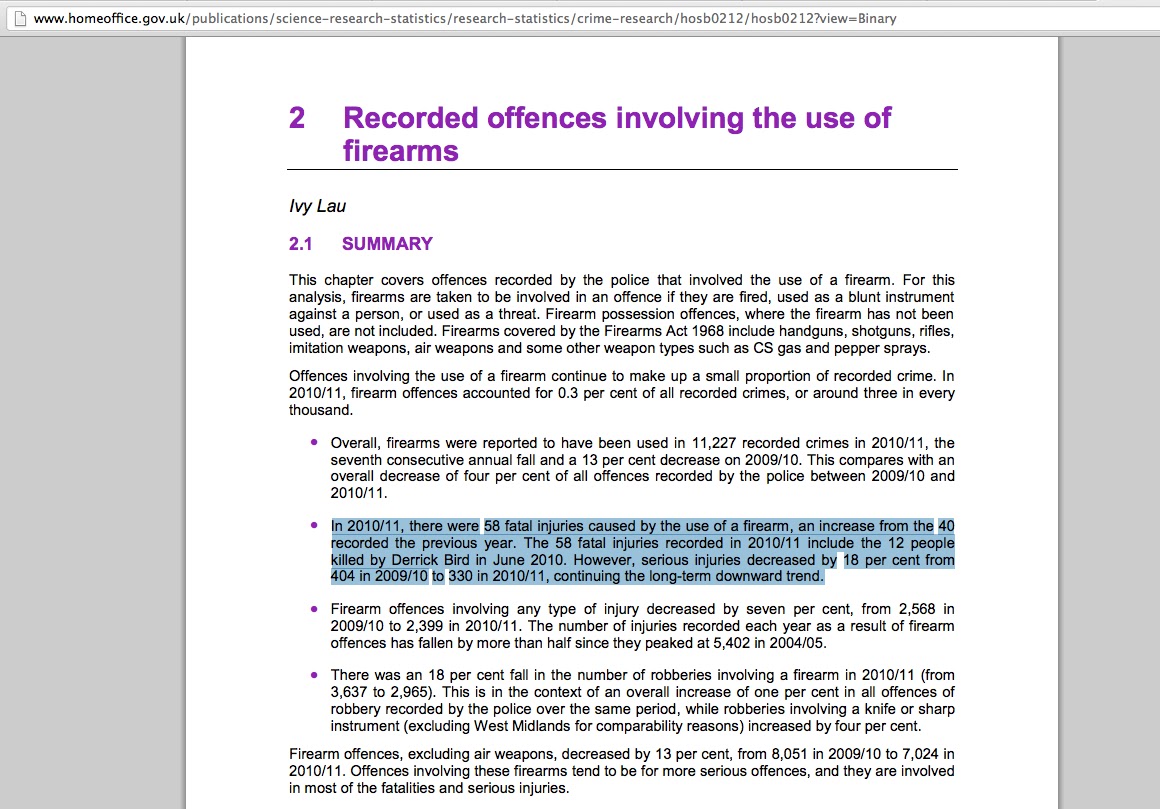
I took screen shots of the relevant data:


These numbers corroborate Morgan's statement. So where on earth did Larry Pratt's 970 come from?  Pratt asserts that: "according to your investigator of your constabulary, the data that you’re using for the murder rate in England is a sham. There’s a monumental misreporting of what constitutes murder. If three people are murdered, it’s likely to be counted as one event."

Is this true!? No, not exactly. Pratt was referring to two articles from The Telegraph. The first is a seemingly extinct 1996 article in which UK police were accused of massaging crime statistics. While this may very well be true, these statistics mainly related to burglaries and vandalism, not homicide. 

The second Telegraph article, which the GOA had archived on its website, gets to the heart of Pratt's assertion. Here are some excerpts: 


Figures to be published by the Home Office this week will massively understate the scale of the problem.
Data provided to The Sunday Telegraph by nearly every police force in England and Wales, under freedom of information laws, show that the number of firearms incidents dealt with by officers annually is 60 per cent higher than figures stated by the Home Office.
The explanation for the gulf is that the Government figures only include cases where guns are fired, used to "pistol whip" victims, or brandished as a threat.
Thousands of offences including gun-smuggling and illegal possession of a firearm - which normally carries a minimum five-year jail sentence - are omitted from the Home Office's headline count, raising questions about the reliability of Government crime data.
"Firearms offences are comparatively rare in Britain, and the vast majority thankfully do not result in a serious or fatal injury. But if the police already collect this information it is difficult to understand why it should not be put routinely into the public domain."
The Home Office crime figures document states: "Firearms are taken to be involved in a crime if they are fired, used as a blunt instrument against a person, or used as a threat."


While we thank Mr. Pratt for enlightening us on the current state of police work in Britain, the manner in which the Home Office reports non-violent gun crimes overextends the framework in which the current argument ought to be couched. Yes, England and Wales are not without their faults, and perhaps the Home Office should be more meticulous when it comes to accounting for non-violent firearm related crimes. However, it is important to note that the statistics that are underreported have to do with firearm related incidents that do not include a weapon being fired, used as a blunt object, or brandished. The underreporting involves smuggling and illegal possession. Violent crimes involving firearms are, in fact, accurately reported. 

Let's stick to the question on the table. Where did Pratt get that 970? 

Well Pratt was citing an article from (you guessed it!) The Telegraph. This article reports that the UK (England, Scotland, Wales, Northern Ireland and some small islands) had 927 total murders in...2009. So, let's just throw all analytical structure out the window and arbitrarily cherry-pick data from whatever year, source and, hell, statistic, we feel like!

Let's compares apples with apples. 

According to the UK's Office for National Statistics there were 550 homicides in England and Wales in 2011/2012. (Looking back at Pratt's figure of 970, I find it very curious that there were more firearm related homicides in the UK than total homicides). Guns accounted for 7.1% of total homicides. There were 640 homicides in all of Great Britain, of which guns accounted for 6%. (These numbers are corroborated by data from the latest Home Office report, which extends to 2011).


Let's compare these figures to the United States.


According to the Center for Disease Control there were 16,259 homicides in the US in 2012. Guns accounted for 11,078 of those homicides, or 68%


The FBI's latest crime statistics show that there were a total of 12,664 homicides in 2011. Guns accounted for 8,583 of them, or 68%


The National Institute of Justice cites a Department of Justice report, showing that 68% of homicides in 2006 were committed with a gun. 


And the final piece of evidence I will submit is this table from the United States Census Bureau, illustrating that guns accounted for 66% of all homicides from 2000 to 2008. 


Larry Pratt may have been right to criticize the UK for certain practices that they employ. Heck, the UK might have some work to do itself. But we have a serious problem here, and the numbers attest to that fact. Whether or not conservatives want it, the gun debate is at the epicenter of public attention. Maybe the argument for stricter gun control won't be borne out by the facts. But let's have an honest debate. Let's get our numbers right. And let's show some intellectual integrity here.